Tax return for 2021: What's new
Submission deadline for the 2021 tax return
You are obliged to submit an income tax return if there is a specific reason. This is known as a mandatory assessment or official assessment.
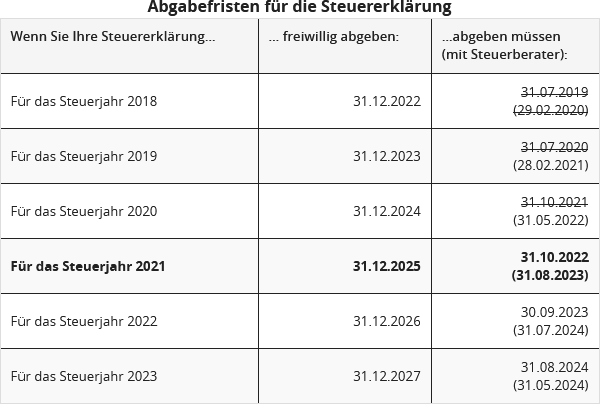
If there is no reason for a mandatory assessment, employees, occupational pensioners and pensioners can voluntarily submit a tax return (so-called application assessment in accordance with § 46 para. 2 no. 8 EStG). In this case, you have up to four years after the tax year to submit, for the 2020 tax return, until 31.12.2024 (§ 169 AO).
The following deadlines apply for submission:
Late submission penalty
Since 2019, new rules for imposing late submission penalties have been in effect, first applicable to the 2018 tax return. In addition to the previously unchanged "may rule", a "must rule" and a minimum late submission penalty have been introduced (§ 152 AO, amended by the "Act to Modernise Taxation Procedures" of 18.07.2016).
Obligation to submit if receiving short-time work benefits
Due to the Corona crisis, the regulations regarding the receipt of short-time work benefits have been changed several times. The duration for receiving short-time work benefits has been extended to up to 24 months. There are also special regulations for the tax treatment of employer subsidies for short-time work benefits and seasonal short-time work benefits. But what do these regulations mean for the tax return?
Individuals who receive more than 410 Euro in short-time work benefits in the calendar year are obliged to submit a tax return. Those who do not submit the return "voluntarily" should bear in mind that the tax offices receive information about the receipt of short-time work benefits via data exchange, may then request the tax return after one or two years, and significant late submission penalties may apply.
Supplementary amounts are also subject to the progression clause (§ 32b para. 1 no. 1g EStG). The employer must enter them in the electronic wage tax statement (for the calendar year 2020) under number 15.
Tax relief: Increase in basic allowance
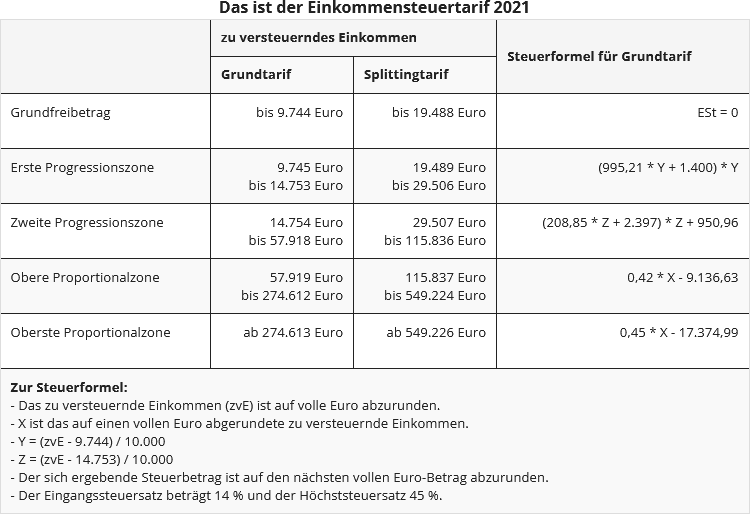
The tax basic allowance ensures that the portion of income absolutely necessary for living expenses is not taxed (existence minimum). On 01.01.2021, the basic allowance was increased from 9.408 Euro to 9.744 Euro. For married couples, the double amount applies (§ 32a EStG). On 01.01.2022, a further increase to 9.984 Euro 10.347 Euro will take place (§ 32a EStG).
Artikel aktualisiert:
The coalition committee decided on 23.02.2022 that the basic income tax allowance will be increased from the current 9.984 Euro by 363 Euro to now 10.347 Euro. This increased allowance applies retroactively from 01.01.2022.
Reduction of fiscal drag
To offset fiscal drag and prevent a creeping tax increase, the key figures of the tax rate are increased by the estimated inflation rate, i.e. "shifted to the right", by 1.52 percent (2021) and 1.17 percent (2022).
As a result of this adjustment, rising tax rates of the progressive tax rate apply only at slightly higher income levels, leaving more net income. Without this adjustment, taxpayers whose income increases only by the inflation rate would pay more tax on average and have less net purchasing power.
The new income tax rate 2021
Wealth tax applies only at higher income
Since 2007, there has been the so-called wealth tax, a tax surcharge of 3 percentage points for top earners. The top tax rate is therefore 45% in the highest proportional zone and applies to taxable income in 2019 from 265.327 Euro or 530.653 Euro (single / married).
In 2021, the highest proportional zone with the 3 percent tax surcharge begins at an income of 274.613 Euro for singles and 549.225 Euro for married couples. From 2022, the highest proportional zone begins at an income of 278.826 Euro or 555.651 Euro.
Marital status: Marriage for same-sex couples from 01.10.2017
Many same-sex couples have taken advantage of the opportunity to convert their civil partnership into a marriage. However, they should now be aware of an important tax deadline: they can apply for joint assessment with the splitting rate until 31.12.2020 - retroactively for all years since the start of the registered civil partnership. This is also possible if the tax assessments are already final.
The prerequisite is that the registered civil partnership was converted into a marriage by 31.12.2019 (Article 97 § 9 para. 5 AO-Introductory Act 2019, introduced by the "Act to Prevent VAT Losses in Online Trading and to Amend Other Tax Regulations"). The subsequent granting of the splitting rate usually leads to a tax refund, so the application should be made immediately if this has not already been done.
Family support: Increase in child benefit and child allowance
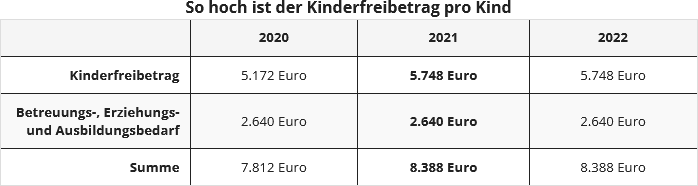
For families, child benefit as well as the child allowance and BEA allowance were increased on 01.01.2021 ("Second Family Relief Act" of 01.12.2020).
Increased were
- child benefit by 15 Euro per child per month.
- the child allowance from 2.586 Euro to 2.730 Euro per parent.
- the BEA allowance (for care and education or training) from 1.320 Euro to 1.464 Euro per parent.
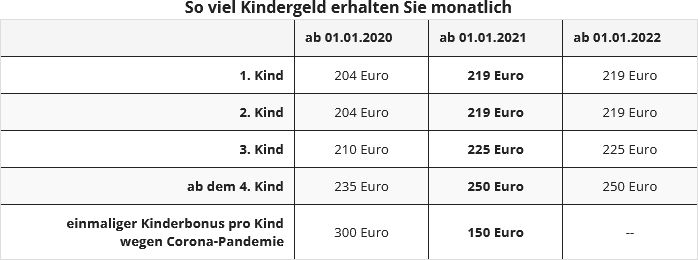
Current: Families have been particularly affected by the Corona crisis. For each child entitled to child benefit, the child benefit will therefore be increased once by 300 Euro in 2020, the so-called child bonus 2020 (§ 6 para. 3 BKKG; § 66 para. 1 sentence 3 EStG). And there is also a bonus in 2021. This amounts to 150 Euro (decided with the "Third Corona Tax Assistance Act").
Relief amount for single parents:
Since 2004, single parents have been entitled to a relief amount if at least one child for whom they receive child benefit or the tax child allowance belongs to their household, and no other adult person lives in the household (§ 24b EStG). The aim of the relief amount is to compensate for the higher costs of living and household management for "genuinely" single parents who run a household only with their children and no other adult person who actually or financially contributes to the household.
The relief amount for single parents with one child was long only 1.908 Euro. Additionally, 240 Euro was added for the second and each additional child. Single parents with 2 children have therefore been relieved by 2.148 Euro since 2015. The relief amount and the increase amount are reduced by one twelfth for each full calendar month in which the conditions are not met.
From 2020, the relief amount was permanently increased from 1.908 Euro to 4.008 Euro and thus more than doubled. The increase amount of 240 Euro remains unchanged (§ 24b para. 2 sentence 3 EStG, amended by the "Second Corona Tax Assistance Act").
Pension from statutory pension insurance
For pensioners who received a pension for the first time in 2021, the taxable portion is 80% of the pension amount. The gross pension amount is 81% taxable, with a standard deduction for income-related expenses of 102 Euro deducted.
In the following year 2022, the full annual pension amount will again be taxed at the taxable rate of 80%. The remaining portion of the pension is then your personal pension allowance, which will remain the same for the entire duration of the pension. From 2023, the full annual pension amount will be taxable after deducting the pension allowance and the standard deduction for income-related expenses of 102 Euro.
Pensions and occupational pensions
Benefits are - unlike pensions from statutory pension insurance - fully taxable as "income from employment" and must therefore be declared in "Anlage N". Benefits have been favoured since 2005 by the pension allowance, the supplement to the pension allowance and the standard deduction for income-related expenses of 102 Euro.
If you retire in 2021, the pension allowance for you is 15.1% of the benefits, up to a maximum of 1.140 Euro, and the supplement to the pension allowance is 342 Euro. Together with the standard deduction for income-related expenses of 102 Euro, the benefits are therefore tax-free up to 1.584 Euro - for life.
Pension expenses: End of the favourable assessment
Pension expenses have been taken into account for tax purposes according to new rules since 2005. Since 2010, there have been three different deduction amounts for pension expenses: for contributions to old-age provision, basic health and long-term care insurance, and other insurance. In contrast, until 2004, there was only a single maximum pension amount for all insurance contributions. To avoid disadvantages, the tax office carried out a so-called favourable assessment ex officio in the following 15 years (§ 10 para. 4a EStG).
In 2020, the previous favourable assessment expired. The tax office no longer checks as part of the income tax assessment whether the new legal situation or the old regulation of 2004 is more favourable for you regarding pension expenses.
Health insurance: Higher thresholds for family insurance
In statutory health and long-term care insurance, family members are co-insured free of charge if their total income regularly does not exceed one-seventh of the monthly reference value. Since the reference value usually changes annually, the income limit for free insurance of family members in statutory health insurance also changes. In 2021, the income limit is 470 Euro per month.
The income limit may be exceeded three times a year without losing the free family insurance. This limitation is lifted, and the regulation is extended indefinitely. If the income limit is exceeded several times, there is the option to voluntarily insure in statutory health insurance.
New home office allowance tax-deductible
From 01.01.2020 to 31.12.2021, employees who work from home and whose workplace does not meet the tax requirements for a home office can claim a flat rate of 5 Euro per day as income-related expenses. The home office allowance is limited to a maximum of 600 Euro per year.
Increase in meal allowances
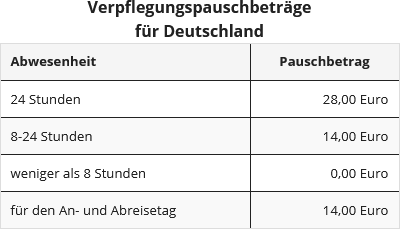
Since 01.01.2020, the meal allowances have been increased (§ 9 para. 4a sentence 3 EStG, amended by the "Act to Further Promote the Taxation of Electromobility and Amend Other Tax Regulations" of 12.12.2019).
New overnight allowance for truck drivers
Since 01.01.2020, a new travel allowance for truck drivers has been introduced, which can be claimed instead of the actual costs. The overnight allowance of 8 Euro per calendar day can be claimed as income-related expenses in addition to the "normal" meal allowance.
Professional relocation: Increase in allowances
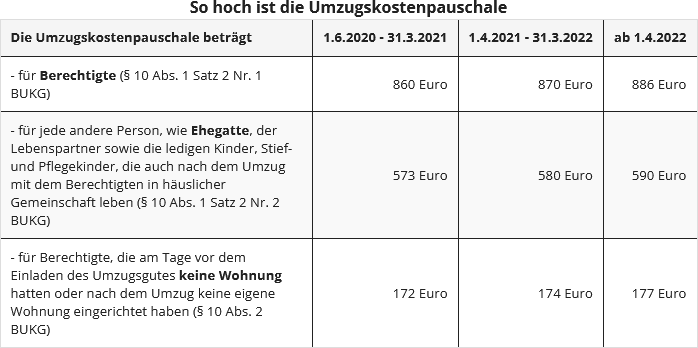
If you move for professional reasons, you can deduct the moving costs as income-related expenses or have them reimbursed tax-free by your employer. This includes transport costs, travel expenses, double rent payments, brokerage fees for a rental apartment, and other moving expenses. While the first-mentioned costs can be deducted in the proven amount, other moving expenses can be claimed with a flat rate.
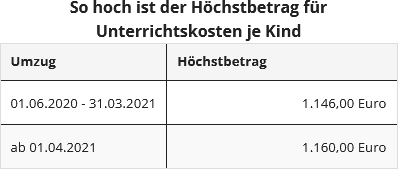
If the children have difficulties at school due to the move, you can deduct "expenses for additional lessons for the children" up to a certain maximum amount as income-related expenses (§ 9 para. 2 BUKG 2019).
Tax relief for charitable organisations
For donations to help those affected by the Corona crisis - regardless of the amount - the simplified donation receipt is sufficient. This is intended to reduce the administrative burden for the supported organisations. (BMF decree of 09.04.2020, IV C 4 -S 2223/19/10003).
Support for dependants: Increase in maximum maintenance amount
On 01.01.2010, the maximum maintenance amount was increased from 9.408 Euro to 9.744 Euro. The maximum maintenance amount is often not granted at this level but is reduced. Namely by one-twelfth for each full calendar month in which the conditions are not met, by own income and benefits of the maintenance recipient that exceed the allowance of 624 Euro, and by one, two or three quarters if the maintenance recipient lives in a country with a lower standard of living.
Tax reduction for energy-efficient renovations
From 01.01.2020, a tax reduction will be introduced for energy-efficient building renovations in buildings used for own residential purposes. 20 percent of the expenses can be deducted from the tax liability over 3 years:
- 7 percent in the first and second year, up to a maximum of 14.000 Euro each, and
- 6 percent in the third year, up to a maximum of 12.000 Euro.
In total, expenses for renovation measures of up to 200.000 Euro per eligible property are eligible for funding. Eligible are construction measures that begin on or after 01.01.2020 and are completed before 01.01.2030 (§ 35c EStG, inserted by the "Act to Implement the Climate Protection Programme 2030 in Tax Law" of 21.12.2019).
Tax classes: Tax class combination upon marriage
Since 01.01.2018, when getting married, both spouses are automatically assigned to tax classes IV and IV (§ 38b para. 1 no. 3 and 4 and § 39e para. 3 sentence 3 EStG, amended by the "Tax Evasion Prevention Act" of 23.06.2017). The tax class combination IV/IV is now the standard for spouses, and the tax class combination III/V is the optional combination. The combination III/V is only granted upon application by both spouses.
The combination IV/IV can therefore also be assigned to both spouses if only one spouse receives a salary. The tax class combination III/V only applies if and as long as both spouses want it. The change from tax class III or V to tax class IV is also possible upon application by only one spouse, with the result that both spouses are assigned to tax class IV.
Multiple tax class changes per year possible
Since 01.01.2020, the right to change tax classes for spouses and civil partners is no longer limited to one change per calendar year (§ 39 para. 6 sentence 3 EStG, amended by the "Third Bureaucracy Relief Act" of 22.11.2019).
(2021): Tax return for 2021: What's new
By when do I have to submit my tax return?
For the 2018 tax return, the submission deadlines were legally extended by two months. This also applies to the 2021 tax return:
- For citizens who prepare their tax return themselves, the submission deadline is extended by 2 months from 31 May to 31 July of the following year (§ 149 para. 2 AO). The 2021 tax return must therefore be submitted by 31.07.2022.
- Citizens who are advised by a tax advisor or income tax assistance association also have two more months to submit their return. While under the previous "deadline decree" an extension beyond 31 December of the following year was only possible on the basis of justified individual applications, there is now time until the end of February of the second following year, i.e. for the year 2021 until 28.02.2023 (§ 149 para. 3 and 4 AO).
But beware: The tax authorities have the option of the so-called advance request. You may therefore have to submit your tax return before the dates mentioned. In any case, high late fees are threatened for late submissions. Their imposition is no longer at the discretion of the tax officer but is mandatory.
SteuerGo
On 19.05.2022, the Fourth Corona Tax Assistance Act was passed in the Bundestag. It stipulated that the submission deadline in the case of compulsory assessment for the 2021 tax return ends on 31 October 2022. The law also regulates an extension of the submission deadlines for the coming tax years 2022, 2023 and 2024.
Submission deadlines for the tax return

Apply for an extension
However, if you can foresee that your tax return will not be ready in the next few weeks, it is better to apply for an extension sooner rather than later. This application should actually be submitted before 31 July 2022 and there is no entitlement to the tax office granting it. It is best to apply for a tacit extension; if you do not hear anything further, your application has been approved. It is important that you provide reasons for your request. These include, for example, a move, a business trip, illness or missing documents. If the tax office accepts the extension, you usually have until 31 December 2023 at the latest.
Tax advisor ensures extension
If you have hired a tax advisor or income tax assistance association, you are in luck. The deadline is then automatically extended to 28 February 2023, unless the tax office expressly requests an earlier submission. The reason for the later date is simple: it is unreasonable to expect tax experts to do all the work in the first five months of the year.
Eventually, a reminder will come
If you do not respond, the tax office will sooner or later send you a reminder and set a deadline. You should take this date seriously, otherwise a penalty payment may be imposed, and a hefty late fee may be incurred. It is therefore better to get in touch in good time.
Voluntary submission allows more time
If you are one of those who are not obliged to submit a tax return, none of this needs to concern you. The tax office does not expect any money from you but will probably have to refund some. For this very reason, however, it is a good idea not to put off the income tax return. Legally, you have long enough: in the case of voluntary assessment, there are generally four years in which the tax return can (but does not have to) be submitted.
Your tax return for 2021 must therefore be received by 31 December 2025 – not a day later, otherwise all the work is for nothing. However, it is better not to exhaust the time limit but to take care of it early. Experience shows that it is easier to gather the necessary documents in the following year than three years later. Moreover, it is about money – who wants to wait four years for the refund?
(2021): By when do I have to submit my tax return?